Shared money
Shared Events: the whole trip, not just the receipts
Author: Davyd Dikenshtein Reviewed on
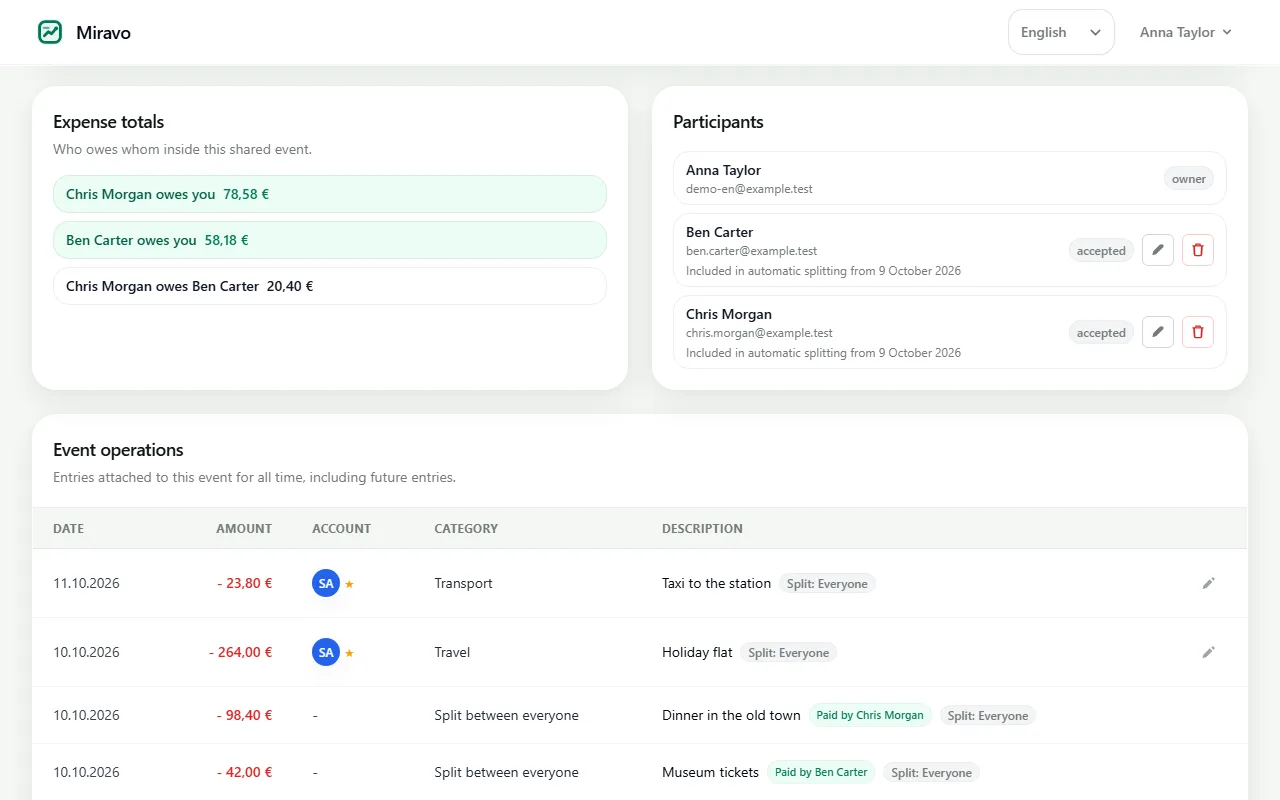
A shared event is a trip, celebration or project whose costs several people record together. Each participant enters what they paid, the event keeps its own running total separate from personal spending, and when it closes it produces the full picture: what it cost, who paid what, and who owes whom and how much.
Example with numbers
A weekend in a cabin for three. Everyone paid for something different.
| Anna: the cabin | €540 |
|---|---|
| Ben: groceries | €210 |
| Chris: petrol | €150 |
| Total cost of the weekend | €900 |
| Share per person (3 people) | €300 |
Who transfers to whom
- Chris → Anna €130
- Ben → Anna €110
- Chris → Ben €20
Example values. As in the app, the transfers show who owes whom and how much, worked out separately for each pair of people.
The conversation nobody wants to have
On a trip, whoever has their card out pays. By the end the record is scattered across several people, several currencies and several memories, and reconstructing it turns into the awkward conversation everyone was avoiding.
Splitting apps solve half of this. They tell you who owes whom, but they sit outside your own finances, so the money you fronted for four other people still looks like your spending until it is repaid.
How it works
-
Step 1
Create the event and invite people
A trip, a wedding, a renovation, a shared flat. Participants join by link; anyone who does not join can still be included by name so the split stays complete.
-
Step 2
Everyone records as they go
Each expense captures who paid and who it applies to. Costs can be split evenly or assigned to a subset, per expense rather than once for the whole event.
-
Step 3
Close it and settle
For every pair of participants the event nets out what they paid for each other and shows who owes whom and how much, along with the total, the split by person and the breakdown by category.
More than splitting a bill
A dedicated splitting app is a debt calculator: it answers who owes whom and stops there. It cannot tell you what the trip actually cost you, or what it did to the rest of your month.
Because a shared event lives inside your own finances, money you paid on behalf of others is treated as owed to you rather than as personal spending. Your forecast is not distorted while the event is open, and event costs stay out of your normal category statistics so one holiday does not skew the year.
Frequently asked questions
Do all participants need an account?
No. Participants are invited by link, and anyone who does not join can still be included as a named participant so the settlement remains complete.
Can costs be split unevenly?
Yes. Shares are set per expense, which matters when only some people joined the restaurant or shared the taxi.
How does an event affect my daily figure?
Only your genuine share counts against it. Money you fronted for others is recorded as owed back to you, so it does not reduce what you can safely spend.
What kinds of events does this suit?
Anything with a start, an end and shared costs: group trips, weddings, renovations, moving house, festivals, or a shared flat over a fixed period.
Related terms
Try it with your own numbers
Free to start, no credit card, and no bank connection required.
Last reviewed: October 19, 2026