Saving
Invisible Savings: money that quietly steps aside
Author: Davyd Dikenshtein Reviewed on
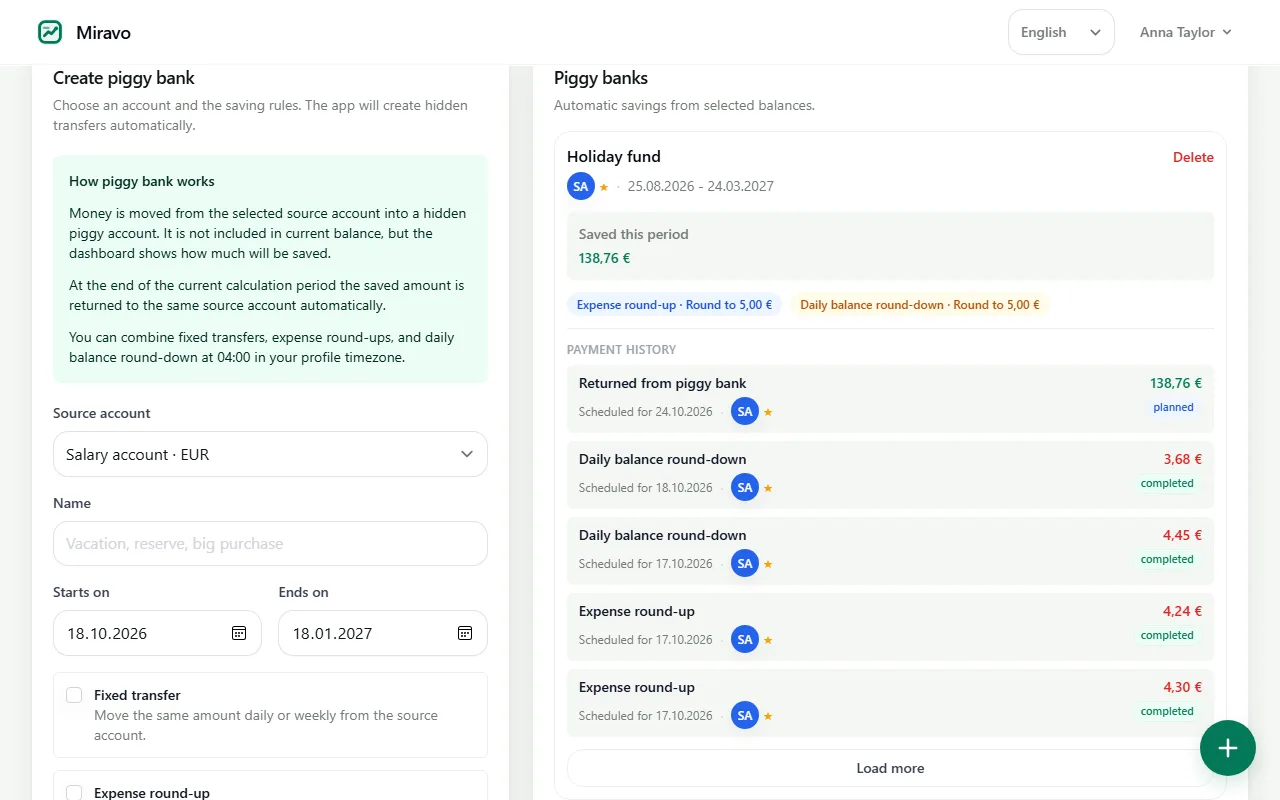
Invisible savings move small amounts out of your spendable balance while a budget period is running, so the money stops being visible as available to spend, and return the accumulated total automatically when the period ends. The mechanism is behavioural rather than financial: it removes the temptation instead of asking you to resist it.
Example with numbers
Six everyday purchases, each rounded up to the rounding step. The difference goes into the savings pot.
Rounding step: €5
| Supermarket €23 → €25 | €2 |
|---|---|
| Bakery €4 → €5 | €1 |
| Pharmacy €12 → €15 | €3 |
| Petrol €47 → €50 | €3 |
| Cinema €18 → €20 | €2 |
| Takeaway €31 → €35 | €4 |
| In the savings pot from these six purchases | €15 |
Example values. The money stays out of your spendable balance until the period ends, then returns to it automatically.
Saving what is left over almost never works
Everyday spending expands to fill whatever is visible. Money that still shows as available tends to be spent, which is why the plan to save "whatever remains at the end of the month" so rarely produces anything.
The usual advice is to try harder. That treats a structural problem as a personal failing, and it is why most saving advice fails for the people who most need it to work.
How it works
-
Step 1
Round up what you spend
Each expense is rounded up to the step you choose and the difference is set aside. With a step of 1, a purchase of 4.30 contributes 0.70. Individually trivial, which is exactly why it is sustainable.
-
Step 2
Or move a fixed amount on a schedule
The same amount moves every day or on one weekday you pick. It is the predictable half of the pair, and it can run alongside round-ups or a daily rounding-down of the balance.
-
Step 3
It comes back when the period ends
The accumulated amount returns to your main balance automatically at the end of the period, once the moment of temptation has passed.
Not the same as a savings pot in a banking app
A pot in a banking app is a labelled container: the money is still yours, still visible, and still a tap away. The label does not change behaviour.
Here the amount leaves your spendable figure entirely for the duration of the period, so the safe daily limit already reflects the saving. What remains is genuinely free to spend, and the money in the pot stays out of everyday spending until the period ends.
Frequently asked questions
Does this need a separate bank account?
No. The pot lives on a hidden account inside Miravo, not at your bank, so no real money moves anywhere; what changes is that it stops counting as spendable.
What if I need the money before the period ends?
Delete the pot. Everything it holds goes straight back to the source account and the daily figure rises accordingly. There is no partial withdrawal; otherwise the money returns on its own on the last day of the period.
How much does rounding up actually accumulate?
It depends entirely on how many separate purchases you make. The calculator on the tools page will estimate it from your own habits rather than from an average.
Related terms
Try it with your own numbers
Free to start, no credit card, and no bank connection required.
Last reviewed: October 19, 2026